Printfriendly

Showing posts with label Faculty&Staff. Show all posts

Opening Letter

As a graphic designer, mentor, friend, and gentle soul, Ira Yarbrough has left
an impeccable legacy on CATS.

Having respect for each and 
every component of CATS, Ira offered his friendship, time, and wisdom to Directors and a plethora of former student 
workers. Unknowingly, Ira’s time and efforts have helped cultivate leaders and define what CATS is today. Ira has set an atmosphere conducive to hopefulness and creativity within each of our 
departments. 

So in honor of such a legacy, we dedicate this newsletter to Ira. Ira, your wisdom, warmth, and kindness will always be 
remembered. 


We aspire to continually use Ira’s legacy as a basis of motivation and 
diligence within our organization.

We love you Ira, 
You will never be forgotten.

Sincerely,

The Center for Academic Technology Support 

IHEC and CATS Multimedia Collab for The Motivational Intervention

David Closson filming on set in WEIU's green room.
Over the summer, CATS Multimedia and IHEC (Illinois Higher Education Center) had the chance to 
collaborate on The Motivational Interventions for College Drinkers  DVD. This project composed of an introduction, first section, and second section. The premise of this project is an interaction between a college counselor and a student seeking help with his drinking habit. 

The directors of this project, Cameron Craig and Pete Grant,  were grateful to receive their second grant-based project together.  Excited about the collaboration, Craig and Grant turned this project into a integrative learning project.  Altogether, there was a team of two graduate assistants from CATS, David Mitchell and Kyle Workman, one student worker, Rebecca Hunt, and students from Tempestas et Caelum Productions, Kole Rushmore and Drenen Martin.

Approached in May 2015 by David Closson, Assistant Director of IHEC, Grant and Craig were eager to allow this project to be completely produced by the students. Previous collaborations with the Multimedia team left Closson very eager and ready to work with CATS again.

Including both video production and captioning, this project allowed the students to have a real experience as 
videographers and captioners; they worked very closely with clients and allowed them to interact with them more. Their main objective, according to Grant, was to satisfy the request of the client. 

Grant believes that doing this project magnifies the talent of the students and helps build their technical skills as well as relationships with faculty on EIU’s campus. He believes for students, the IHEC project was an opportunity to flourish and grow as leaders.

Pete Grant training
Peter Grant on set training David Mitchell
A month after production had commenced, the project had been completed in entirety. Utilizing Canon XF300s, WEIU’s green room, and various post-production software enhanced the knowledge needed for future clients. 

Even though this project only included the captioning team and multimedia (videography) team, Grant hopes to include other departments in CATS to help with future projects. 

In light of it all, Grant and Craig continually aspire to provide 
students with opportunities to expand on captioning skills, 
videography skills, and graphic design skills. In the future, they want to obtain more grants to provide more networking and growth opportunities for the students.
Grant also states that this project made him knowledgeable about the grant-writing process, along with things to look for when searching for grants.


For more information regarding this story, contact: Pagrant@eiu.edu or cdcraig@eiu.edu


New Learning Module Implemented into Multistep Problems on D2L

Aiming to enhance the way students have learned multistep problems, Dr. John V. Cabage, an assistant professor in the school of technology, has developed a method he believes will accomplish this goal. Using randomized variable problems (each student receiving a different homework problem), he believes that he has a 
cheat-proof and a highly interactive way for students to learn mathematical problems. 

Despite the constraints, he aspires for this program to help students collaborate more frequently and gain a greater knowledge of the content. 

Used within D2L, the multistep problems are provided for each corresponding chapter alongside to an instructional video that provides guidance on how to approach the problem.  

With the successful implementation of the multistep mathematical problems, Dr. Cabage intends to incorporate another idea into D2L: LTI. An LTI, short for learning tools interoperability, will take information from outside programming and put into a format for D2L to recognize. Then, he would link the outside program with the multistep problem. He would then be able to put it into PHP, C++, or any other various programming or scripting languages that he would choose for D2L.  With the intention of moving the LTI forward, he hopes to have a graduate assistant to assist with the production of this idea. 

Dr. Cabage feels this project is unique because it is an idea that is new to the School of Technology’s learning management system; furthermore, he also believes that this program will allow students to learn from their mistakes because it would be easier to track the mistakes in calculations for particular problems. 

In addition to locating mistakes, he hopes this program will aid in the student learning at a more realistic pace. Of course, the pace would be highly dependent on the student’s timeliness and work ethic. 

Along with the recent implementation of the multistep mathematical problems beginning in June 2015, he intends to see results within a year. 


For information regarding this story, please contact: jvcabage@eiu.edu

Technology and Biology Go Hand-in-Hand

For Dr. Gary Bulla, Professor and Associate Chair of the Biology department, research has never been about reaching an end-point but obtaining as much knowledge as possible. His most recent research project, titled The Genomic Analysis of Liver Function, has proven this idea to be true. Lasting over four years, Dr. Bulla, with the help of graduate assistants and student workers, has worked diligently to understand what makes the liver function.  

Focusing from a microscopic perspective, he and his research team of four intend to get a broader understanding of the breakdown and processes of a failing liver. To perform such an experiment, Dr. Bulla utilizes liver cells from Rats to analyze the breakdown process. Specifically, he looks for mass irregulated genes and put them into non-liver cells.  From this he then coaxes them to make the non-liver cells into liver cells. 

The machine used to observe such abnormalities in genes plays a vital role in the actual observation of the genes. With the micro rays, the team incubates the micro rays and them washes them off with a media. After, they place micro rays inside of the machine and observe the fluorescents that shine off the dots and provide the team with a read out of the processes.

Though making it this far was no-straight shot. During these four years of research with micro rays, Dr. Bulla has went through a series of three different types of microforms. Progressively, the readout has become more accurate and innate for him to read. 

Dr. Bulla goes on to say, “Its amazing what you can do, what never thought was possible.” An experiment that once seemed both scientifically and financially impossible is now tangible for both students and professors of Eastern Illinois University. Dr. Bulla mentioned that within the last ten years, the type of scientific technology has allowed to more access to students. Not only that, but the technology has developed in a manner which provides more accurate results and allows the duration of experiments to be shortened significantly.


Everyone can agree the molecular reason why the liver does not function is the question at hand, but he focuses the experiments on the students. His main objective is to provide the students with experience which will further help them in their scientific careers. 

Down the line, Dr. Bulla hopes to work with new equipment to better understand RNA strands and continually provide research opportunities to both graduate and undergraduate students. 

For more information concerning this story, please contact: gabulla@eiu.edu


Reflections of Ira By Michael Babcock

 I had the privilege of sharing an office with Ira for eight years. We shared a lot. We shared stories, thoughts and feelings about everything from the disheveled squirrel outside our office window to confidences I have only shared with a handful of good friends in my life.  

Ira had a pleasant calm about him, a warmth and ease. He had a great sense of humor and loved to laugh. If i were to do the math (and i just did), I probably spent close to 20,000 hours with Ira. I would guess we spent about 10,000 of those laughing, hard. It’s how we started most of our days. Over coffee, we shared stories about life, art, love, children, parents, and occasionally even work. We laughed about all of it.

Ira had the respect and admiration of the entire office. He was the foundation of CATS and the glue that held it together. He was a mentor, a friend, and a refuge on stressful days. No matter what the circumstance, everyone wanted to hear his perspective. He always gave an honest opinion and presented it with tact and respect. He understood and valued the thoughts and perspectives of everyone around him, whether he agreed with them or not. I would guess Ira’s advice was sought after by everyone in CATS at one point or another.  

Sunday Morning Smile, 2001, mixed media.
Acquired by Booth Library. 
Ira was a hard worker who always had the best interests   and future of CATS in mind. This newsletter was his creation and an example of his desire for CATS to succeed in serving the EIU community. With every individual CATS hired, Ira was looking ahead. He had a real gift for understanding the dynamics of an office. Several of us are here right now because Ira saw something in us. I am absolutely certain i wouldn’t have the good fortune of working here if it weren’t for him.  

I’m not sure everyone knew how talented of an artist he was. He had been, and 
continued to be, a successful and prolific painter. His 
portfolio speaks volumes of his work ethic and his view of the world. His landscapes tend to focus on the warmth and beauty that surround us. Through color and light, he brought out all that was good. I think he was able to see that sort of potential with all those around him. 

Ira was truly an asset to EIU, and I feel blessed to have had him as a colleague, a mentor -- and most of all, 
a great friend.     


For information regarding this story, please contact: mwbabcock@eiu.edu

Michael Babcock: A Man With a Vision by Dustin White

There’s no such thing as “downtime” for CATS videographer Michael Babcock; his work is always in demand, and the past few months have been no exception. 

“Over the last two years, we’ve averaged over a video per week out of this office,” said Babcock, whose 
award-winning work is featured all over EIU’s website and is also used for
 recruiting purposes when prospective students are on
 campus for visits.
Babcock captures footage of band students at
Mattoon Middle School

Throughout the summer, one of Babcock’s projects has been to film nearly 50 short interviews with faculty 
members from all four of EIU’s colleges to get their 
perspectives on being educators.

“The whole thought was to have short little glimpses into their personalities,” said Babcock of his faculty subjects, “to give a prospective student an idea of who they’ll someday have in a classroom.”

Babcock says the short pieces have an intentionally low production value in order to make them feel as candid and relaxed as possible. If they’re well-received and the university’s colleges and academic departments find them effective and useful, additional faculty members will be approached.

“This was kind of a test,” said Babcock. “If we feel like they work, we’ll do more of them when more faculty are around.”

In an effort to secure footage for several outcome pieces to be featured on EIU 360, Babcock also made a quick trip to Nashville along with student assistant Chris Boswell and Jay Grabiec, whose photos will also be used online and in recruiting pieces.

The team caught up with five successful Eastern alumni during that two-day, one-night trip, procuring enough material for at least as many videos. Babcock says the scheduling for such a quick trip is definitely a challenge but totally worthwhile.

“Logistics are tough when scheduling, but the end result is a ton of good content that can be useful in a variety of ways,” Babcock said, adding that the experience is particularly invaluable to Boswell as he sharpens his skills. A similar trip was taken to Chicago in Fall 2014, and Babcock says the hope is to head back north for a second time this semester.

Aside from Boswell, Babcock has received extensive help from Frank Lanham, an unpaid summer intern and a junior film major at the University of Notre Dame but hails from Charleston and is home for the summer months. In exchange for some credit hours, he has provided an extra pair of capable hands on many of Babcock’s 
summer projects.


“Frank picks things up really quickly,” said Babcock. “When I communicate an idea or concept, he understands immediately.”

Said Lanham, “For me, it’s been great to interact with the equipment here and get some time working with all the editing software – just logging time. I’m getting ready to take some more advanced production classes at Notre Dame, and this’ll give me a good head start.”

It remains to be seen, but Lanham may very well have lent a hand on some award-winning work. Babcock’s videos have been entered in many competitions over the past few years, bringing home some impressive hardware. Take the Case V Awards, for example: his video for the “An Appetite For Change” story on EIU 360 beat out 47 other entries from prestigious universities (like Harvard, for instance) from all across the nation. Here’s what the judges had to say about it:

“This video did a fantastic job of taking a subject and topic that wouldn’t normally be visual and made it so. We liked that the video bridged teaching and research effectively and made the research relevant. The story connected academics and the classroom to the research, and it connected the students to the teacher. The artistic opening shots (such as panning the mailbox) were beautiful. These subtle artistic effects throughout the video brought out an emotional reaction to the piece. Technically, this video was well-edited and produced, and had a compelling aesthetic style. It fell in line closest to good cinematography (different frame rates, matching to the music). This can be a difficult subject to capture on video, but they delivered the message perfectly.”

For Information regarding this story, please contact: wdwhite@eiu.edu

CATS Alumni Spotlight: Jamie Kemp

Coming from Springfield, Ill., Jamie Kemp has proven herself to be a valuable component of the Center for Academic Technology Support for quite some time.  Beginning her student worker position in 2009, Jamie worked for Michael Babcock. With Babcock, she engaged with the world of video editing  along with minor graphic design projects. Through the close relationship with Babcock, she then was introduced to Antoine Thomas, the former Training Specialist for the COL, the Center for Online Learning, where she began doing minor web design work.

Working for Thomas, Jamie gained a valuable relationship with former graphic designer Pete Taylor. She worked closely with Taylor, learning new skills and advice for future endeavors. She stated, “Through this task, I got the chance to learn from PeteTaylor about web designing, and because of that relationship, I was awarded the graphic designer position within the web office.”

Once in the web office, Kemp was able to get her hands dirty: from web designing for the Doudna, to web designing for the Whiteside Gardens, and finally, her most recent work, the home page for Eastern Illinois University’s website. In the web office, with the collaboration of University’s Marketing and Communication team, Jamie’s work has expanded to all of Eastern’s benefit. Doing minor work outside of CATS, Kemp has proclaimed herself exclusively a graphic designer for EIU.

Even with all the success, she says she would not have the fortune of being a great graphic designer without the help CATS.  At CATS, Kemp has learned the importance of the levels of communication. Once a graphic design major, keeping her work exclusively for her eyes was key, but she now works and collaborates with her team within the web office. Providing input on her designs, she claims it has helped make her a better graphic designer and still gladly accepts feedback.

She states “We collaborate as a team within the web office—I created the design and I hand it off to Ryan.”

In the future, Kemp intends to continually grow as an artist and ambitiously pursue projects that  challenge her creativity. 

A Collaboration to Bring Campaigns to Life for Illinois Premier Boys' State

“Advertisement for this organization [was] key.”

Over the summer, Gabriel Grant, an instructor in the school of technology and coordinator for Digital Printing Laboratory, had some assistance while filming the campaigns used for the Illinois Premier Boys’ state. With the helping hand of CATS Multimedia, the young men were able to learn 
post-production editing and how to utilize video equipment. 

While the young men were training and practicing patriotism, engagement in civic process, and learning leadership skills, Mr. Grant took it upon himself to aid the young men in making their campaigns and ideas come alive. Typically, it remained 
traditional to publish newspapers, but with financial hurdles, a new, creative idea was brought to life. Grant says, “I don’t think their reactions can captured on ink and paper; their reactions need to be captured visually.” 

Providing shotgun microphones and lighting equipment, Grant was in a position to bring life to this idea. Tasked with limited time, Mr. Grant was unable to thoroughly teach post-production editing to the young men; he turned to CATS Multimedia team for assistance in training, along with administering the green screen backdrop used.

Provided with a graduate assistant, Mr. Scott Wilkinson, Mr. Grant aided the young men in learning Adobe Premiere Pro in a condensed time period (three to four days). With the assistance of Mr. Wilkinson, the young men were able to learn how to use a non-linear editing software, which left them with more refined editing skills and knowledge of SLR cameras.

Adding the final touches on the project, Grant explains he was happy to provide the young men with “higher quality” equipment and felt that this experience would help them in the near future. Each of the videos completed were broadcasted via YouTube and were published on a nightly basis. 

Grant added that the videos were a great advertisement tool for Illinois Boys Premier, and the parents were ecstatic about seeing all that went on in the organization.

In the summer of 2016, Grant plans to work with Illinois Girls’ State Premier to provide similar results.  He also plans to utilize the services of CATS once again. 


More information on the Illinois Boys’ State Premier can be found on their website (http://illinoisboysstate.org

For more information regarding this story please contact: gjgrant@eiu.edu

The Proliferation of Social Media Platforms within the FCS department

From the birth of the centennial celebration to the emergence of Pinterest within classrooms, there has been a drastic change in the manner of communication to promote various ideas and content on and off campus.

Dr. Michelle (Mikki) Sherwood
“What I notice is that through our Pinterest post, a gateway is opened that allows people to explore Eastern Illinois University” says Dr. Michelle Sherwood, an Interim assistant chair and professor within the Family and Consumer Science department. Through the utilization of Facebook, Instagram, Pinterest, and Linkedin, Dr. Sherwood has created a virtual community comprised of multiple groups: faculty, alumni, students, former professors, and residents of Charleston. With the help of these social media platforms, the FCS department has delved into a virtual world, which allows everyone to connect and observe what is taking place on campus.


From the Spring of 2014, the start of the centennial celebration for the FCS department, there emerged the beginning of the departments’ Facebook page.  Dr. Sherwood states, “One of our components was we wanted to do one hundred hours of community service for the university and the community; we wanted to celebrate one hundred years of FCS.  So, what happened was it really got people moving.“  Involvement grew from this movement within the community and with the students; many of the events held on campus would soon be showcased on Facebook along with an abundance of photos. 


The department’s utilization of social media platforms grew with hundreds of hits on Facebook; however, the FCS department did not start using social media platforms avidly until the fall of 2014. As activity of these accounts grew, so did the content; the FCS department expanded their pages from just events to postings from instructors, alumni postings, job openings, recognition of students, and a plethora of information concerning those within the FCS department. 


While the load can be heavy, everyone with a relation to the FCS department has a responsibility to a different task. Sherwood states, “We have an alumni in Chicago who runs our Linkedin page, our graduate coordinator runs our MS and FCS graduate page, and I do Pinterest. So we assign different responsibilities to different individuals according to their occupation and relation with the department.“

She has also mentioned that their motives for running the pages were based on the excitement of the students.  She goes on to say what makes the FCS department’s social media initiatives exclusive is their ability to feature the students; through the use of social media platforms, the department is able to pay recognition  to those who do great things within the school of Family and Consumer Sciences. 

Dr. Sherwood eagerly hopes to maintain a healthy involvement with the social media pages and anticipates stronger connections with current, former, and prospective students. 


For more information regarding this story, please contact: mlsherwood@eiu.edu

ITC Showcases Advantages of New Office 365 in ‘30 Days’ Blog Series


Students migrated to the new Microsoft Office 365 email system in May 2014 with faculty and staff accounts beginning the transition in October. Tom Grissom, Director of the Instructional Technology Center (ITC), wanted to help instructors adapt to the high-impact move and also help them realize it can be so much more than an email system. To do so, he created a blog series called “30 Days with Office 365 for Educators.”

Grissom received a test account two weeks prior to the transition and realized he was going to get a lot of questions regarding Office 365, so he created the blog series to help the whole EIU community.

If you visit the ITC website (eiu.edu/itc), you will see, on the left-hand menu, a link called “ITC Chronicles Blog.” By visiting the link, you can get an overview of the “30 Days with Office 365 for Educators” postings. If you click on a specific entry, the article expands so you can read more in-depth about that particular topic. For example, day one’s entry gives a rundown of the new Panthermail system.

“Office 365 is the office suite in the Cloud. It is like a main frame,” says Grissom. “Think of the Cloud as these massive parallel-computing clusters on the Internet.”

The new system provides faculty and students access to the four major Office applications including Word, PowerPoint, Excel, and OneNote. You can use them locally by downloading the applications to your computer, or you can use a browser to access them online in the Cloud. Connecting to these applications online gives you the ability to share documents in real time, have co-authors, use survey tools and much more.

OneDrive, a cloud-based file storage system, is the foundation of Office 365. Instead of carrying a USB drive everywhere you go, you can store documents in the Cloud and access them from any computer by logging into your account.

“OneNote is one of the most underrated tools in education,” states Grissom. “It is like a digital 3-ring binder, with different tabs and pages that can be used on different platforms.” Day 23 in the blog series goes into more detail about the application.

“These tools have opened up a whole other world; imagine the possibilities,” Grissom says. “Office 365 is very user friendly, very powerful, very collaborative and it offers us world-class capabilities. We can do so much more now. The tools are here, but it is up to us to use them.”

For more information visit the ITC website, eiu.edu/itc, or contact Dr. Grissom via email: gtgrissom@eiu.edu.

Real-Time Polls & Collaborative Research Technologies; By Clinton Brown

This past September I presented on a conference panel focusing on increasing student engagement through media and technology. While there are many technologies well suited for these goals, two platforms have received little attention within higher education, but have tremendous possibilities to enhance instructional practices and engage students. PollEverywhere and SearchTeam are two web-based technologies that are institutive, easy to use, and have countless applications inside and outside of the classroom. The best part, they’re free! A detailed explanation follows below.

Poll Everywhere – Overview (www.polleverywhere.com)

On the surface, Poll Everywhere is a simple application that works well for live audiences using mobile devices like smartphones. People participate by visiting a fast mobile-friendly web page for your event, sending text messages, or using Twitter. Instructions are displayed on-screen. The poll that is embedded within the presentation or web page will update in real time. Advanced uses include texting comments to a presentation, texting questions to a presenter, web voting, and SMS interactivity in print, radio, and TV.

Participants may vote by following the instructions shown on the poll when it is displayed. The poll does not need to be displayed to actively receive votes, but it does need to be "started" by the presenter on the edit poll page. In the US, you send a text message to the number 22333 that contains a voting keyword, like 1234, or blue.

Additionally, individuals may also vote via your poll's web page on Poll Everywhere, via an embeddable voting widget, on a phone's web browser using PollEv.com, or via Twitter.

In short, Poll Everywhere is a useful tool to provide real-time feedback and also facilitates interactive presentations. It is well suited for small classrooms or large lecture halls.

SearchTeam – Overview (www.searchteam.com)

SearchTeam is a collaborative search engine. However, this platform offers many more advantages over traditional search engines for individuals and groups.

To start with, you can use SearchTeam to efficiently research the Web for information. You start your research by creating a SearchSpace on a topic of interest. From within a SearchSpace, you can search the Web, videos, images, books and more. You can find and save only what you want while you are searching and throw away what you don't want or find irrelevant. You can automatically organize what you save into folders of your choosing. Everything is automatically saved into your personal account and you can return to your searches any time and continue from where you were previously.

What makes SearchTeam unique and valuable is that you can do your searches collaboratively with others you trust, such as friends, colleagues and family members. You can invite any set of people you trust to search with you from within a SearchSpace. An invitation is sent via email to those people you invite to join your search. When they enter your SearchSpace, they see exactly what you've found and saved so far. They can comment on or like your findings. They can chat with you from within the SearchSpace, and do further searches relevant to that topic and save more results into the SearchSpace. All changes made by any collaborator are relayed to all other collaborators in real-time, so everyone is instantly in sync with what others are doing.

In addition to finding and saving search results, SearchTeam goes further to enable you to enrich your SearchSpace with knowledge that may come from other sources. You can upload documents to a SearchSpace to share your relevant reports / presentations, etc. You can also add links to Web resources that you may have received from others via email or social networks. You can even
create new posts to share your knowledge on the topic directly inside the SearchSpace.

Together, as a team, you can leverage the collective effort to find good quality information, and benefit from the collective knowledge on any topic efficiently.

In effect, SearchTeam is traditional Web searching + Wiki-like editing and saving capabilities + integration with your trusted circle of people through social networks like Facebook, LinkedIn and Twitter + real-time collaboration with people you trust. What this delivers to you is a new and more effective way of using the Web to find, save, organize, share and leverage collective knowledge
through people you trust.

For more information contact Clinton Brown via email: clbrown3@eiu.edu.

Art Department Utilizes Desire2Learn for New Masters Program

When prospective students consider studying art, they generally consider in-class coursework that deal with two- or three-dimensional projects, as well as in-class with critiques. However, the art department has recently developed an online graduate program that brings a whole new meaning to art education.

Dr. Patricia Belleville, an art education professor and the department’s graduate program director, has spent the last two years working to develop the Master of Arts in Art with Art Education and Community Art options program. This program is offered online -- with a few hybrid courses -- and relies on the Desire2Learn (D2L) online environment for completion of a majority of the coursework.

Screenshot of Pinterest art collection
Some projects students have completed include the creation of a map of their art education history and posting images of contemporary art practices. Each of these projects is shared on the discussion board in D2L, which allows other students to comment. “The discussion forums are not just about writing, but also more of a creative outlet for the students,” Belleville stated. The students have even been developing and curating an art collection on the Pinterest social media site.

“One of the students collected drawings from her son, providing information about how old he was and the time when his artwork was created. Another student used work from non-professional art learners in grades 11 and 12 that he had taught,” added Belleville.

The online format makes the program accessible to anyone. One student is currently enrolled while living and working as an art teacher in Thailand. He found out about the program via social media and decided it would be a good way to earn his master’s degree while teaching abroad.

Because its students are enrolled in two courses each semester, this graduate program is not like any other program on campus. One course is during the first 8-week session and the second course is during the second 8-week session. This allows students to focus on one course at a time. It also allows students to begin the program during the middle of a semester if they wish to do so.

Vineyard map of Art
Education History
As previously mentioned, hybrid courses are also offered. This means students come to campus for one week in the studio and complete the remaining three weeks at home. If students begin and go straight through the program, it is possible for them to complete the program in two years.

“How can we help these teachers get an advance in their pay grade and have it so that they can work their schedules around it?,” Belleville questioned. “This program is for certified art teachers and allows for them to be in different parts of the country and share their difference experiences with each other.”

For more information contact Dr. Patricia Belleville via email: pkbelleville@eiu.edu.

General Chemistry Gets More Interactive with Tablet and Mastering Chemistry

“Blackboards are hard to see, PowerPoint doesn’t interest the students enough, and SMART boards are too sensitive,” says Dr. Hongshan He, an assistant professor and general chemistry instructor. General education courses are pretty large, ranging from 45-60 students per class; so how does he get students involved? Dr. He has found several new ways to make his course more interactive.

Dr. He writing on tablet
Dr. He was able to obtain a Redden grant, which he used to purchase a Microsoft Surface Pro 3. He writes directly on this tablet during lectures with an electronic pen, which goes straight onto the projector screen so his class can see. Students can also practice problems on the Surface Pro 3 and others can see their work. Dr. He says: “Calculations and drawings are hard to type out and draw on PowerPoint, but the tablet makes it much easier because you can write it all out.” He has received positive feedback from students and other teachers who have sat in on lectures.

“Our students come from all different backgrounds. A lot of them work and can’t always make it to class,” stated He. If they miss a lecture, it is hard for them to do well on upcoming homework and exams, but what if they could view the lectures on their own time? During Dr. He’s lectures, PowerPoint automatically records anything he writes on the slides. So besides posting the lecture notes on D2L, Dr. He can upload the problem solving processes he went through -- as well as the lecture itself -- by using video software called Camtasia. Students can access the videos on their laptops or even cell phones once they log into their D2L account. Students can’t always come back to school in the evenings for review sessions, so instead of hosting them, He can post a video of how to solve a particular problem. The videos also provide more opportunities for extra help outside of class.

The chemistry department uses an online homework assignment system called Mastering Chemistry. This system is through Pearson, the company that provides the textbooks. Using Mastering Chemistry is nothing new, but a tool called Learning Catalytics is. Students can login to Mastering Chemistry to access Learning Catalytics and answer in-class practice questions on their smartphones. Students are always trying to use their cellphones in class; instead of preventing it, Dr. He decided to let them use it for class purposes. He can also record attendance by asking his students to answer a question through this new tool. The responses automatically sync to Mastering Chemistry and the students can earn bonus points by attending the lecture. This helps with minimizing the distractions during class so students can concentrate.

Dr. He is trying out all these new technologies in his general chemistry courses, but hopes to expand them into others once he knows how well they are working. These technologies make the learning process more personal, convenient, and efficient for both teachers and students. Dr. He is hoping that in the future the university can provide funds for all faculty members to get their own tablets to use in different departments, such as math and
biology.

For more information contact Dr. Hongshan He via email: hhe@eiu.edu.

Department of Special Education Employs Hybrid Model for Students

When Desire2Learn was adopted at EIU, the Department of Special Education began offering its first course to employ a hybrid model. Since then, special education professor Melissa Jones-Bromenshenkel has utilized D2L, along with other online resources, to implement a cohort-style hybrid model for her Special Education graduate course.

D2L Course Site
The idea of starting an online hybrid model began when the department realized some of its candidates would be traveling great distances for classes — some from as far away as Chicago. Many of the students enrolled have full-time jobs or are involved in other activities, and there was a great deal of information to share, as well as learn, in the course.
“Using technology allows the candidates to have a quality learning experience while making the most efficient use of their limited time,” stated Jones-Bromenshenkel.
Using LiveBinder
Using Porta Portal


The Special Education graduate-level course being merged into the online model is called Assessments, Programs and Services for Students with Exceptionalities and English Language (SPE 5675). The course relies heavily on Desire2Learn, but also incorporates other online tools – like Porta Portal, Evernote, Pinterest, and LiveBinder – to compile an “electronic resource” file for candidates to use in their future roles as administrators or teacher leaders. The file can include online modules, YouTube videos, websites and much more. SPE 5675 is offered to students enrolled in Education Leadership cohort programs in Decatur, Champaign, and Mt. Vernon. 

Using Pinterest
The various technology tools are used to communicate information  including modules, assignments, and lectures with features, such as discussion boards, collaboration, chats, and emails. It is also used to complete class assignments—the Electronic Resource file and the Collaborative-Data Based Plan, which involves the analysis and display of various types of data. 

The hybrid course has been very beneficial for future school administrators across the State of Illinois, but, as with many new experiences, there are bumps. Dr. Jones-Bromenshenkel added: “Student feedback, professional development, and trial and error have helped the course evolve and I plan to continue revising and enhancing it as new technologies and information become available.”

For more information on the hybrid Special Education graduate course, contact Dr. Melissa Jones-Bromenshenkel, via email: mljones2@eiu.edu.

Physics Professor Utilizes D2L to Enhance Course with Associated Lab

Online courses are becoming more common today with technology advancements. Students are capable of completing items done in the classroom from the convenience of their own home. With this in mind, the Department of Physics at Eastern has outfitted one of its general education courses with an associated lab online.

Mr. Nenad Ilic
Nenad Ilic, the department’s academic support professional, is using the learning management system Desire2Learn and the voice and video calling software Skype in a unique way. The general education course Adventures in Physics (PHY 1052G) now comes with an associated lab (PHY 1053G) combined into an online format.

Ilic has taught a variety of physics courses including general education courses covering mechanics, thermodynamics, and electromagnetisms. “Technology provides an opportunity to reach a broad audience and train students to develop a variety of computer skills,” he stated. “Delivering a course online requires students to be more proactive, post comments, ask questions, and work more independently.”

The online course is based on the D2L platform and combines the functions of working in a classroom with online learning. Lectures that would take place throughout the week in a classroom setting are available as study modules for the students with homework assignments, tests, and sometimes essay topics; all based on the study modules.

The laboratory section of the course is online as well. When the students register for the course, they are instructed to order a lab package. This includes all the equipment needed to complete laboratories at home – with the exception of supplies like water and cups. For the course, students are required to complete 12 labs using the provided lab kits. The labs entail experimental procedures, data collection, analysis, and answers to provided questions. Students are required to submit lab reports as well as complete an online teleconference using Skype to demonstrate they have full understanding of the lab material.

Ilic noted: “The online course offered provides an opportunity for the university to reach a wider audience for students who cannot attend regular on campus classes and students of other universities that can obtain the necessary credits at their institution.” 


For more information, contact the Physics department via email: physics@eiu.edu.


Career Skillet Website Bridges Professionalism Gap Between Faculty and Students

How many times has a student come to your class with a paper due and asked for a stapler? Many faculty members think this is irresponsible while students tend to disagree. There is a vast disconnect between what faculty and students believe is irresponsible.  The Career Skillet website was developed to bridge the professionalism gap between faculty and students. 
Dr. Michelle Sherwood and her colleague, Dr. Jill Bowers from the University of Illinois, launched Career Skillet in July 2013.  Dr. Bowers has a research interest in emerging adulthood and Dr. Sherwood has two children who are emerging adults. With the help of some focus groups, the two combined their knowledge to develop the user-led Career Skillet website.

Dr. Sherwood began focusing on her children and the struggles they have had understanding professionalism and commonly used buzzwords that go along with it. She began looking into the classes she taught and asked her students to describe professional words, like networking. Many students would respond with: “We know we are suppose to do it, but what is it exactly and how do we do it?”

Screenshot of Career Skillet Website
The Career Skillet website is self-funded and targets emerging adults (students from high school to university) and is filled with information based on what they have been told by the emerging adults and the needs those emerging adults have identified. There are also sections related to the Family and Consumer Sciences field, including what FCS is, what FCS has to offer, jobs you can get specific to FCS, and FCS-related professional organizations.

Dr. Sherwood incorporates the use of the website in her graduate courses as well. Her Adolescents and the Family (FCS 5852) course and Current Issues and Trends in Family and Consumer Sciences (FCS 5460) course have focused activities which teach her students to apply research to everyday life. If the activities are of high quality, they can publish them on the Career Skillet website. Anytime there is a guest author on the site, it is very likely to be a student from her course or perhaps a student from the University of Illinois.

Professional presentations are developed and given by Drs. Sherwood and Bowers regarding the Career Skillet website as well. They have presented at the Illinois Association of Family and Consumer Sciences, the National Association of Family and Consumer Sciences, and the Illinois Council on Family Relations.  They also use the presentations in their undergraduate core classes as an informational resource. “As we have done presentations to students about this website, their feedback has been fascinating,” Sherwood stated. “There are just basic things they do not know and when you stand in front of them as a faculty member, it makes you realize the gaps in what they did not know.”

Dr. Sherwood has also received some funding through Eastern to pay for photos and hosting.  She has also recently received a Winkleblack grant which will help fund the next idea they want to add to the website called “Nailed It, Failed It.” Her idea is to have students sit in on a mock interview where she can provide feedback after the interview and it can then be posted online. Viewers will then have the chance to vote if the student nailed the interview or failed the interview. The grant will help provide the video equipment and capabilities needed for this undertaking.
“Research shows that emerging adults want to participate in things. They want to be able to interact,” Sherwood added. “We are trying to make it fun and incorporate Buzz Feed articles, things of that nature to add to it.”
For more information visit the Career Skillet website (www.careerskillet.orgor contact Dr. Michelle Sherwood via email: mlsherwood@eiu.edu.

Expedition Endurance: An Inquiry to Human Survival

Why do people continue to flock to the Southwest after retirement? This is a region that is desperate for water, but is growing in population. Cameron Craig, geographer and professor in the Geology/Geography department, wanted to further research the aspects of water usage in the Southwest to educate Midwesterners on how water is used.

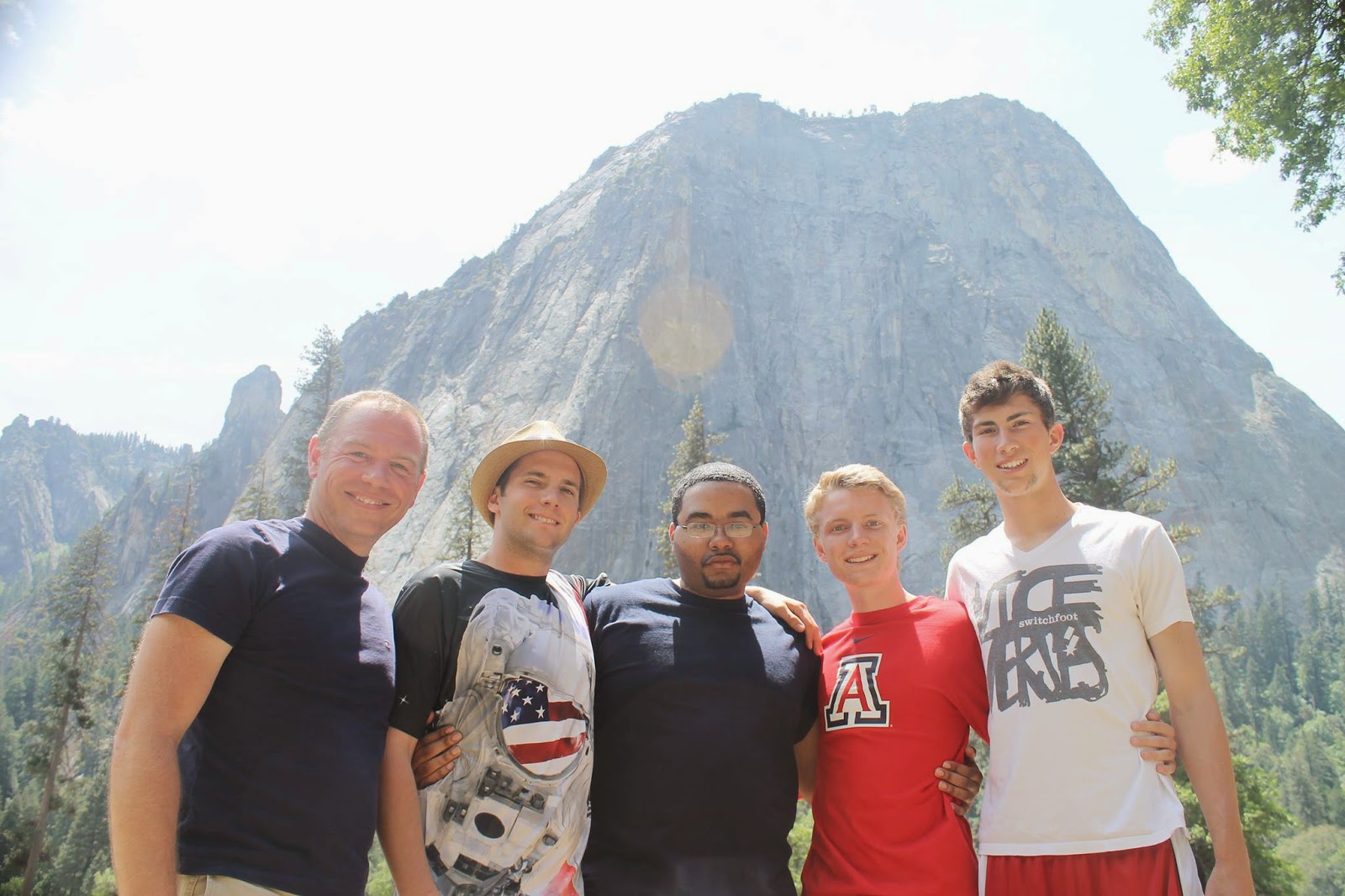
This summer, Craig took four students on a 14-day expedition to the region. Those on the trip included: Craig, project leader Nate Page, student director; Aric Pelafas, Darius Holland, and Jay Bushen. They traveled through New Mexico, Arizona, southern California, Utah and Colorado to talk with many individuals associated with water resource management. Each student was responsible for finding and setting up interviews in particular regions. 
“There were a lot of ‘firsts’ for the group, which was exciting for me to see,” said Craig. “Most of the students had never been anywhere in the Southwest before, and Yosemite National Park and the Grand Canyon was a first for all of us.” 
Aric and Cameron talk with Brian Werner about
water conservation practices for landscapes
The trip was very educational for the entire group. While in the Tucson area, the group met up with a past student, Kevin Jeanes, who serves as vice president of Craig’s film company Tempestas et Caelum Productions (TCP). Jeanes was excited to see these new faces in the TCP family. In Central Valley of Huron, Calif., the group talked with some local farmers who spoke in their native Hispanic tongue. Craig stated: “A human being that used to be happy can no longer be happy, because they cannot do what they did for years — farm.” Craig is also continuing to work with some of the members he met with on the trip.

The Tempestas et Caelum Films Facebook page has been a hit with 351 likes so far. It was a learning experience not just for the students and Craig, but also for those who followed them on Facebook. They each kept a daily diary about what they learned and experienced and shared with their followers who loved reading their reflections. TCP Films continues to receive comments and questions about the project and how we can think differently about water resources. 

Early this fall, TCP Films will be traveling to local schools presenting an educational experience about how we should be thinking about water in the Midwest. They will also be traveling to surrounding areas, including Indianapolis, Champaign, and Chicago, to present a circuit lecture series to educate residents about the project. The ultimate product from this project is a documentary film which they plan on airing on WEIU and surrounding PBS stations in the Midwest in late October or early November.

The TCP Films Family in Yosemite Valley
“We are grateful for those who helped fund the trip,” said Craig. Next year, Cameron Craig would like to take students out west to see how they deal with water resources there. 

Craig concluded: “I take students out, because I want to relive what it was like for me through their eyes. It is an expedition--we are exploring something new. Not necessarily new out there, but it’s new for me and the kids.”

For more information regarding the integrative learning trip visit tcpfilms.com or contact Cameron Craig via email: cdcraig@eiu.edu.
Powered by Blogger.